KOREA ESSENTIALS · TRANSPORT
T-money Card in Korea: How to Buy, Top Up & Use It
First Korea Trip · Updated August 27, 2026
Last fact-checked: August 27, 2026 · How we verify travel information
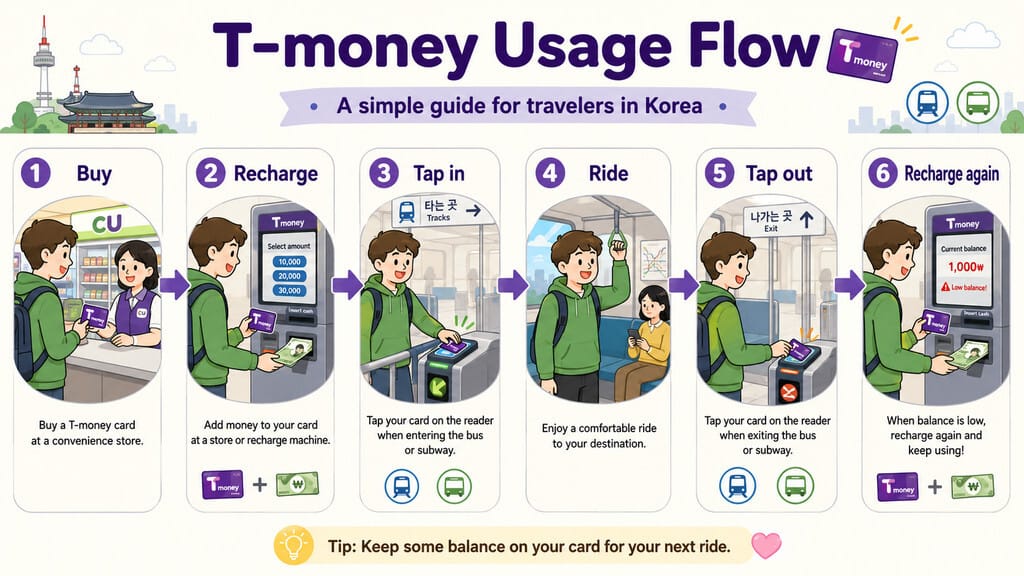
A T-money card in Korea is one of the easiest ways to use public transportation on a first trip. Buy a physical card, load Korean won onto it, then tap the same card when you enter and leave the subway or when you board and get off a bus. The standard card also works on many taxis and at participating convenience stores.
QUICK ANSWER
- Buy a regular T-money card at a major convenience store or a subway station vending machine that sells T-money cards.
- For a standard physical T-money card, foreign-issued cards are not accepted for purchase or top-up, so keep Korean cash available.
- Tap when entering and leaving the subway.
- On buses, tap when boarding and again before getting off.
- Recharge when the balance gets low, and spend or refund the remaining balance before leaving Korea.
| Quick fact | What to know |
|---|---|
| Standard card price | About ₩3,000; special designs may cost more. Loaded balance is separate. |
| Where to buy | Major convenience stores and supported subway locations. |
| Physical-card top-up | Cash is the standard method for foreign visitors under current KTO guidance. |
| Main use | Subways, buses, many taxis, and participating stores. |
| Registration | No ID, sign-up, or app required for a standard physical card. |
Where to Buy a T-money Card in Korea
A standard T-money card is widely available. T-money’s current foreign-traveler guide lists major convenience stores such as GS25, CU, 7-Eleven, and Emart24, as well as subway station vending machines, as common purchase locations.
- GS25
- CU
- 7-Eleven
- Emart24
- Supported subway station locations
The standard card does not require a passport, account registration, or an app before use. If you are buying it at a convenience store, simply asking for a “T-money card” is usually enough.

How Much Money Should You Put on T-money?
You do not need to load a large amount on day one. T-money’s current traveler guidance suggests roughly ₩30,000–₩40,000 as a starting balance for a typical 3-night, 4-day trip with regular sightseeing and public-transport use.
For context, the Seoul Metropolitan Government currently lists the adult subway base fare at ₩1,550 when using a transportation card, effective June 28, 2025.
A better strategy is to start with a reasonable amount and recharge later. Your actual spending depends on how many rides you take and how far you travel.
How to Recharge a Physical T-money Card
For a standard physical T-money card, keep Korean cash available for top-ups. The Korea Tourism Organization’s May 2026 transportation and payment guide states that foreign-issued credit cards are not accepted for standard prepaid T-money purchase or top-up and lists cash as the supported method.
- Convenience store: hand the card to the cashier and say how much you want to add.
- Subway station machine: choose the recharge option, follow the language prompts, and add cash.
Mobile T-money products and tourist-specific cards can have different payment rules. This guide focuses on the standard physical T-money card because it is the simplest baseline for a first-time visitor.
How to Use T-money on the Subway
- Check the line and direction before the gate. Make sure you are entering toward the correct destination.
- Tap the card on the reader. Wait for the confirmation before walking through.
- Keep the same card for the entire trip.
- Tap again at the exit gate. The system calculates the fare based on the journey.
You do not need to buy a separate subway ticket for every ride. If the balance is too low, recharge the card before trying the gate again.
How to Use T-money on a Bus
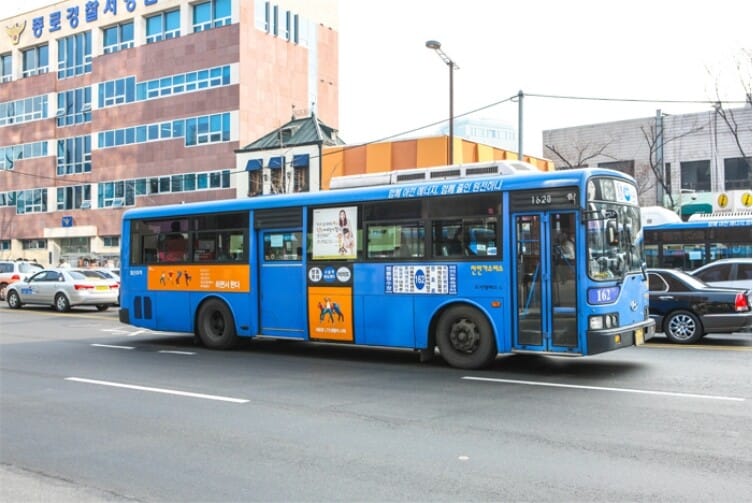
The bus rule to remember is simple: tap when you get on, and tap again when you get off.
- Tap your card on the reader when boarding.
- Press the stop button when your stop is approaching.
- Tap the card on the exit reader before getting off.
T-money warns travelers that forgetting to tap when leaving a bus can cause transfer discounts to be lost and can result in an additional charge.
How T-money Transfers Work in Seoul
Seoul’s integrated fare system can apply transfer discounts when you use the same transportation card and tap correctly when boarding and getting off.
- Normal transfer window: within 30 minutes of getting off the previous ride.
- Late-night/early-morning window: within 60 minutes from 9 PM to 7 AM.
- The same card must be used throughout the eligible transfer sequence.
You do not need to calculate the discount yourself. The practical rule is simply to use the same card and remember to tap off.
Where Else Can You Use T-money?
A standard T-money card is not limited to the Seoul subway. T-money can be used widely on subways and buses across Korea, as well as in many taxis and participating stores.
For a first trip, it is still best to think of T-money primarily as a transportation card. Look for the T-money logo instead of assuming every store or service accepts it.
Can You Refund the Money Left on T-money?
Generally, yes. The remaining balance can be refunded at eligible T-money refund locations, although the available location and refund method can depend on the balance.
If only a small amount remains, spending it at a participating convenience store before departure can be simpler than requesting a refund. For larger balances, check T-money’s current refund locations and conditions before you travel.
5 T-money Mistakes First-Time Visitors Should Avoid
- Forgetting to tap off the bus. This can affect transfer discounts and charges.
- Loading too much money immediately. You can recharge later.
- Assuming a foreign card can top up a normal physical T-money card. Keep some Korean cash available.
- Using different cards during a transfer. Use the same card for the trip sequence.
- Leaving Korea without checking the balance. Spend or refund the remaining value if practical.
T-money Card FAQ
Is T-money only for Seoul?
No. A standard T-money card can be used on public transportation in multiple regions across Korea. Coverage can vary by service, so check the reader or T-money logo when in doubt.
Do I need a passport to buy a normal T-money card?
No. T-money’s current traveler guidance says a standard physical card does not require ID, sign-up, or an app.
Can I recharge a physical T-money card with my foreign credit card?
Current KTO guidance lists foreign-issued credit cards as unsupported for standard prepaid T-money purchase and top-up. Keep Korean cash available. Other T-money products can have different payment rules.
Do I tap T-money when getting off a bus?
Yes. Tap when boarding and again before getting off. This is important for correct fares and transfer discounts.
How much should I load for a short trip?
There is no fixed amount. T-money’s current traveler guide suggests roughly ₩30,000–₩40,000 as a starting point for a typical four-day trip, then topping up if necessary.
Official Sources
- T-money — Getting Around Korea After You Arrive: The Only Transit Card Guide You Need
- Korea Tourism Organization — International Visitors’ Transportation & Payment Guide, May 2026
- Seoul Metropolitan Government — Modes of Transport and Current Fares
The simple version: buy the card, load some cash, tap in, tap out, and recharge when needed.
Travel information can change, especially payment methods and transportation rules. Double-check anything important before relying on it during your trip.