KOREA ESSENTIALS · SENIOR TRAVEL
Seoul With Elderly Parents: How to Avoid Long Walks, Stairs and Hills
First Korea Trip · Updated October 1, 2026
Last fact-checked: August 27, 2026 · How we verify travel information
The difficult part of Seoul with elderly parents is often not the attraction itself. It is the walking you do before and after it.
A subway trip can include a walk to the station, long corridors, a transfer, stairs, an elevator that exits on the wrong side of the road, and another walk to the destination. A palace can be accessible and still be enormous. A neighborhood can look close on a map and still be uphill.
The most useful planning idea is to treat your parents’ walking energy as a daily budget. Spend it on the places they came to see, not on avoidable transfers and hills.
Think in an Energy Budget, Not a Sightseeing Count
Seoul has extensive public transportation and many accessibility facilities, but “accessible” does not always mean “low effort.” A station may have elevators while the easiest elevator route is farther from the attraction. A transfer can add long corridors. Large attractions still require walking once you arrive.
That means the right question is not “How many stops is it?” It is “How much walking does this entire trip require from the hotel door to the attraction and back?”
If an older parent tires easily, saving 15 minutes of transit is less useful than removing 20 minutes of stairs and uphill walking.
Use the Subway for Simple Trips and Taxis to Remove Friction
The Seoul subway is fast and inexpensive, but it is not automatically the easiest option for an older traveler. A short trip with one awkward transfer can take more physical effort than a taxi ride across the same part of the city.
Use the subway when the route is direct and the elevator access is convenient. Use a taxi when it removes a transfer, hill, long corridor or the exhausting final walk back to the hotel.
Seoul’s official taxi guidance notes that app-based taxi services can show an expected fare in advance, including services designed for international users. For public transport basics, see our Seoul Subway Guide for Tourists. For taxi fare problems, see how to avoid unfair charges.
The Subway Exit Matters More Than the Station Name

The closest exit on a map is not always the best exit. A slightly farther exit with an elevator can be much easier than a staircase beside the attraction.
Seoul publishes accessibility-facility information by station, including elevators and escalators at major tourist stations such as Gyeongbokgung, Anguk, Myeong-dong, Gwanghwamun and Ichon.
Before leaving the hotel, check four things: which exit has the elevator, whether the route has a transfer, how far the attraction is from that elevator, and whether the last section is flat or uphill.
If you are using buses and subways through the trip, our T-money guide covers the payment routine.
Large and Hilly Attractions Need Editing
Gyeongbokgung: choose the highlights
Gyeongbokgung is important and large. Trying to see every corner can use a big part of the day’s walking budget before lunch.
Visit Seoul publishes a barrier-free Gyeongbokgung route connecting major areas such as Gwanghwamun, Geunjeongjeon, Sajeongjeon and Gyeonghoeru. Wheelchair and stroller rental is also listed at Heungnyemun Gate, although availability can be limited.
Even without following the exact route, the principle is useful: choose the main sights first and make the rest optional.
Bukchon: do not treat the full walking course as mandatory
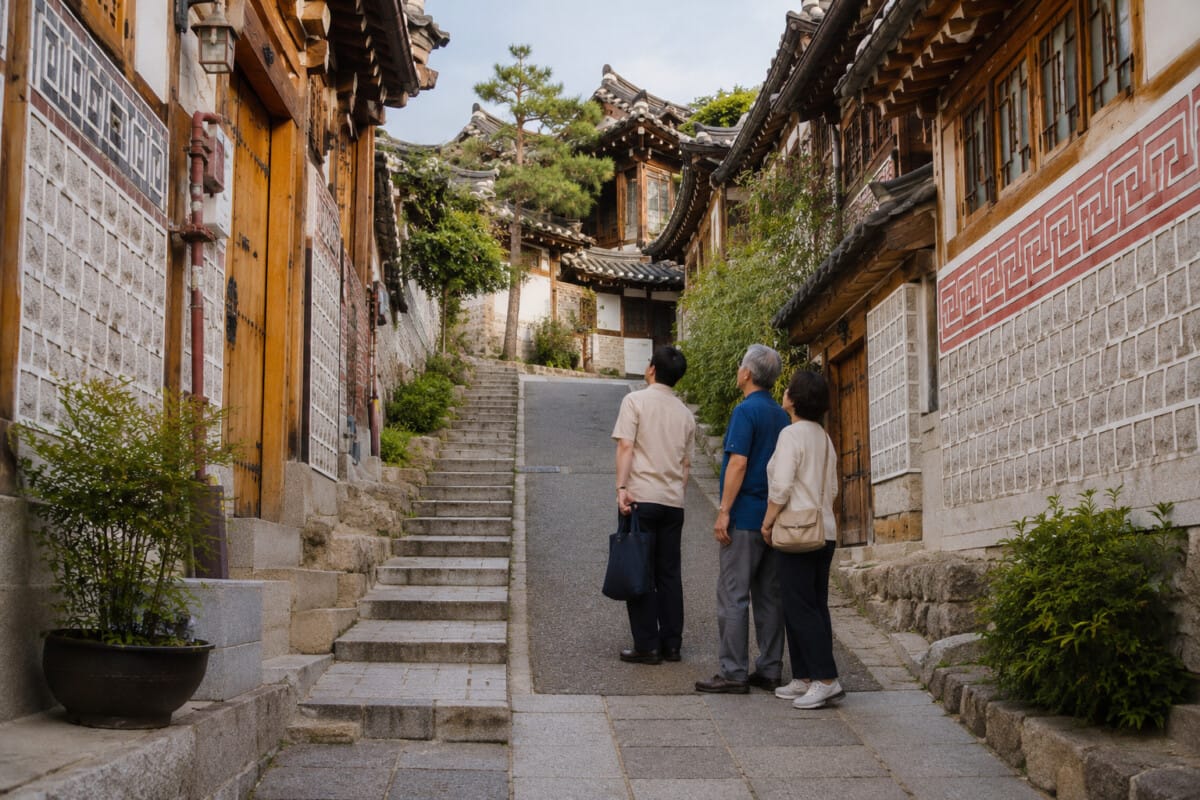
Visit Seoul’s Bukchon material describes a walking course of roughly two to three hours and includes uphill streets, downhill sections and stone stairs. That does not mean elderly visitors need to skip Bukchon. It means the full course is a poor default.
A more practical version is Anguk → a manageable part of Bukchon → a café break → taxi to the next stop.
Visit Seoul currently lists restricted visiting hours in designated residential areas, with entry prohibited in restricted zones from 17:00 to 10:00. Check the current boundary and visitor rules before going.
Namsan: use transport for the climb
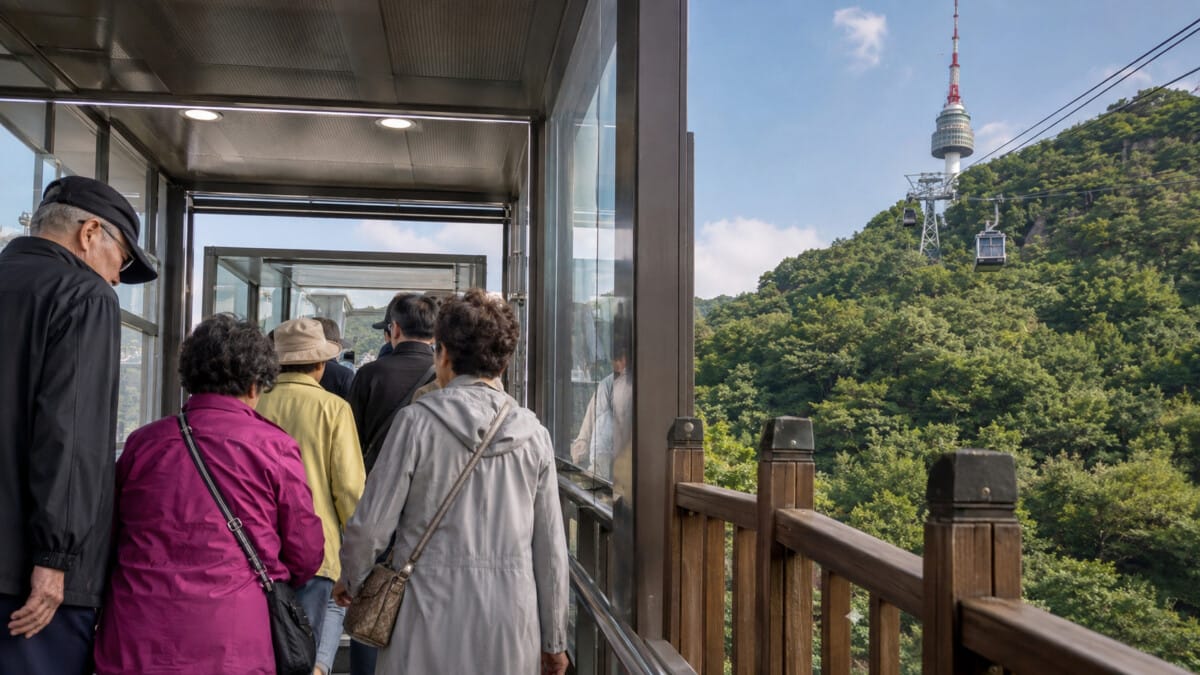
N Seoul Tower looks close to Myeongdong on a flat map. The missing information is elevation.
Official visitor information lists bus access, the Namsan Cable Car and the Namsan Orumi outdoor elevator that helps visitors reach the cable-car platform. If the view is the goal, use the access infrastructure and save the walking for the top.
National Museum of Korea: good for a recovery day
The National Museum of Korea can work well after several demanding days because it provides elevators, escalators, cafés, restaurants and wheelchair rental. The official directions also note elevator access around Ichon Station and the underground Museum Nadeulgil connection.
The museum is large, so accessibility is not a reason to see every gallery. Pick the exhibitions that matter and use seating and café breaks without treating them as lost time.
Keep Each Day Geographically Compact
Crossing Seoul several times in one day can be more tiring than the attractions themselves. Every cross-city move adds station entries, exits, waiting and walking.
A lower-effort historic day might be Gwanghwamun + selected parts of Gyeongbokgung + a nearby meal. A Bukchon day can stay around Anguk and Insadong. A museum day can stay around Ichon and finish early if energy is low.
Do not pre-commit to every nearby attraction. Add the next stop only if everyone still feels comfortable after the main one.
Choose the Hotel for the Last Walk of the Day
“Near the subway” is not enough information when walking stamina matters. A hotel can be close to a station and still sit uphill or beside an exit with stairs.
- Is the route from the useful station exit flat?
- Does that exit have an elevator?
- Can a taxi stop close to the entrance?
- Are cafés, restaurants and convenience stores nearby?
The hardest walk is often the one back to the hotel after sightseeing. A slightly less fashionable location can be the better base if it makes that final trip easier.
Use Seoul Danurim When Extra Mobility Support Is Needed
For parents with substantial walking difficulty or mobility-aid needs, check Seoul Danurim before the trip. Seoul’s official accessibility guidance includes seniors aged 65 and above among eligible users for travel-convenience services.
Danurim provides accessibility information and services related to travel aids and accessible transport. Eligibility, reservation rules and availability differ by service, so do not assume every senior automatically qualifies for every vehicle or piece of equipment.
This is one of the places where checking the official service before arrival is more useful than trying to improvise after a difficult day.
Official Sources
- Visit Seoul — Accessibility and Seoul Danurim Tourism Services
- Seoul Metropolitan Government — Subway Accessibility Facilities
- Seoul Metropolitan Government — Taxi Information and Taxi Apps
- Visit Seoul — Barrier-Free Gyeongbokgung Palace
- Visit Seoul — Bukchon Hanok Village Walking Tour
- Visit Seoul — Bukchon Hanok Village Current Visitor Information
- Visit Seoul — Namsan Cable Car and Namsan Orumi
- National Museum of Korea — Directions and Ichon Station Access
- National Museum of Korea — Visitor and Accessibility Facilities
Accessibility facilities, rental availability, visitor restrictions and transport services can change. Check the exact route or service before relying on it.