HELP & PROBLEMS · MEDICAL HELP IN KOREA
Sick in Korea? How Tourists Can Find a Doctor, Hospital or Pharmacy
By Terry · First Korea Trip · Updated September 3, 2026
Last fact-checked: September 3, 2026
If you get sick in Korea, the first question is not “Which famous hospital should I go to?” It is how urgent the problem is and what level of care you actually need. For a minor problem, a pharmacy may be enough. For symptoms that need an examination or prescription, look for a clinic or hospital. If you believe the situation is a medical emergency, call 119.
You do not need to solve the Korean medical system before getting help. The practical route is to choose the right level of care, use official search tools or a nearby clinic, and bring enough information for staff to understand your symptoms, medications and insurance situation.
Quick answer: pharmacy, clinic, hospital or ER?
| Situation | Start here |
| Mild symptoms or an over-the-counter medicine question | Pharmacy (약국) |
| You need a medical examination or prescription | Local clinic (의원) or hospital outpatient department |
| You need a larger hospital or specialist-level care | Hospital / general hospital |
| You believe your health or life is in immediate danger | Call 119 or go to an emergency room (응급실) |
| You need tourism information or interpretation help | 1330 Korea Travel Helpline |
Do not use a travel helpline instead of emergency services. Korea Tourism Organization guidance lists 119 for medical emergencies. The 1330 Korea Travel Helpline is useful for non-emergency tourism information and interpretation support.
ON THIS PAGE
If it feels like an emergency, call 119
For a medical emergency in Korea, call 119. Korea Tourism Organization lists 119 for fire and medical emergencies, and Korea’s emergency-reporting guidance also directs people to 119 in urgent situations.

You do not need to decide whether your problem “deserves” an ambulance by comparing yourself with other patients. If you believe there is an immediate threat to life or serious health, use emergency services instead of trying to navigate across the city to a particular hospital on your own.
If communication is difficult, keep the message short. State that you need an ambulance, give your location as precisely as possible, and use simple English or a translation app if needed. A hotel front desk, station employee or nearby Korean speaker may also be able to help communicate your location, but do not delay an emergency call while searching for an interpreter.
When a Korean pharmacy may be enough
For a mild, non-emergency problem where you mainly need advice about an over-the-counter medicine, start with a pharmacy. The Korean word is 약국 (yakguk), which is useful to paste into a map search.

Korea Tourism Organization’s pharmacy guide recommends using a translation app and, when useful, showing a photo of the medicine or active ingredient you normally use. Tell the pharmacist about allergies and other medications instead of simply asking for a product that “looks similar.”
A pharmacy is not a substitute for a medical examination. If your condition needs a prescription, diagnostic testing or a doctor’s assessment, you will need a clinic or hospital.
Useful information to show a pharmacist
- Your main symptom and when it started
- Any medication allergies
- Medicines you already take
- A photo of the medicine, packaging or active ingredient you normally use
- Any important medical condition that could affect medication choice
How to find a clinic or hospital in Korea
For most non-emergency illnesses that need a doctor, a nearby outpatient clinic is the simplest starting point. You usually do not need to begin at one of Seoul’s largest university hospitals for a routine problem.
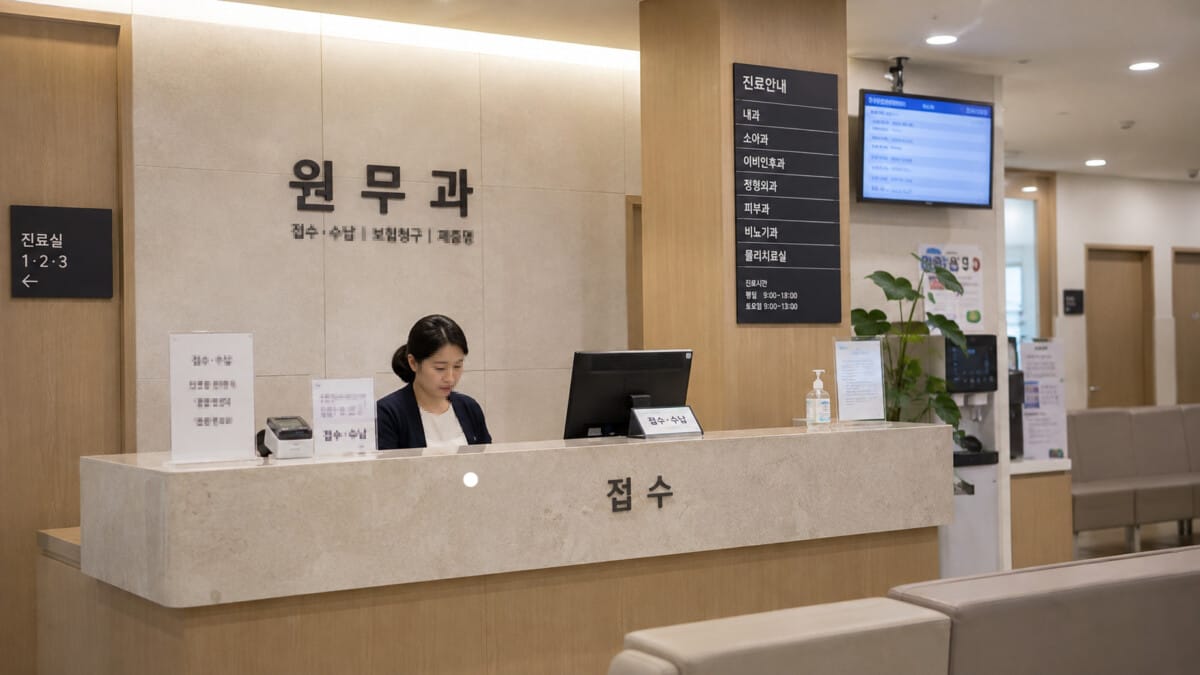
On Korean maps, 의원 generally indicates a clinic and 병원 means hospital. 응급실 means emergency room. Searching the Korean term can produce better local results than searching only in English.
If you are not comfortable searching Korean place names, our NAVER Map guide for tourists explains how to search and navigate in Korea.
For a hospital that specifically handles international patients, the government-supported Medical Korea website provides directories of registered hospitals and accredited institutions. Listings can include an international healthcare center, contact details and available interpretation languages. Check the specific facility before traveling there because language support and operating hours vary by hospital.
Do not choose a hospital only because its English website looks good
For a straightforward illness, distance and opening hours may matter more than finding the biggest international hospital in Seoul. For specialist care, a complicated medical history or a situation where language support is especially important, an international healthcare center can be worth the extra planning.
What if you do not speak Korean?
Do not assume every doctor, nurse or pharmacist will be able to conduct the entire visit in English. Larger hospitals may have international healthcare centers or interpretation services, while a small neighborhood clinic may have little or no formal language support.
The 1330 Korea Travel Helpline can help with tourism information and interpretation in multiple languages. It is useful when you are trying to communicate a non-emergency travel problem or understand where to go. It is not a replacement for 119 in a medical emergency.
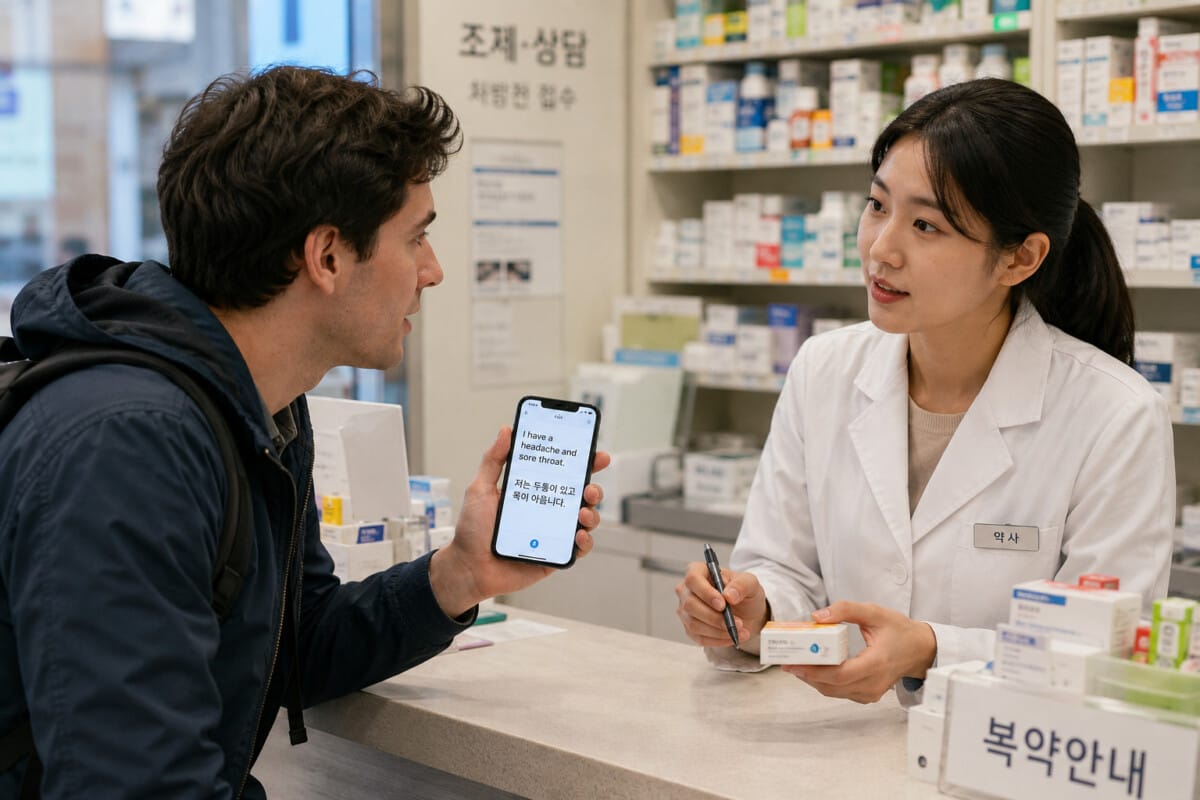
Translation apps can also make a routine visit much easier. If you are still setting up your phone for Korea, see our Korea travel apps guide.
Prepare a short medical note on your phone
Before you arrive at the desk, type a short note that staff can read or translate:
- Main symptom
- When it started
- Known allergies
- Current medications
- Relevant medical conditions
- Your travel-insurance company and policy details, if applicable
This is more useful than trying to explain everything from memory while you are tired, feverish or stressed.
What to bring to a clinic or hospital
- Passport or another form of identification, if available
- Your travel-insurance policy information
- A payment card and another payment method if possible
- A list or photos of medications you take
- A list of allergies
- Any important medical records you already have access to
- A reachable phone number or email address
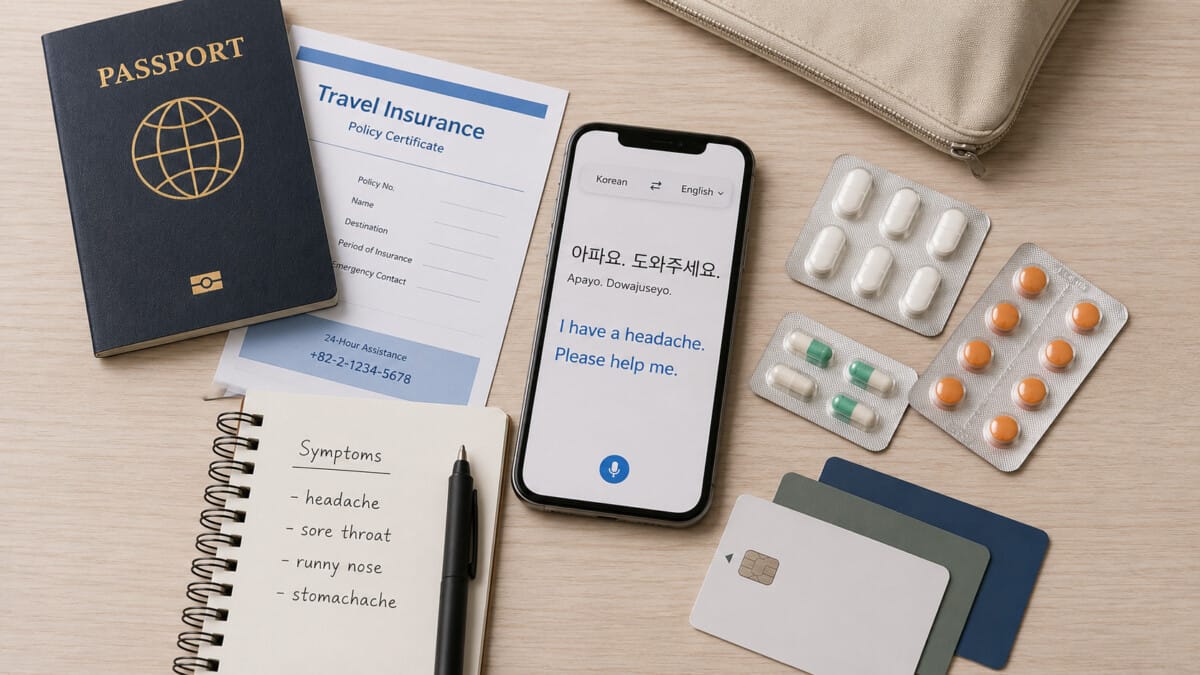
If you need documentation for an insurance claim, ask the hospital or clinic what receipts, medical certificates or itemized documents it can issue before you leave. Your insurer may require specific paperwork, so check the insurer’s instructions as early as practical.
How payment and travel insurance usually fit in
Do not assume that a short tourist stay automatically gives you Korean National Health Insurance coverage. The National Health Insurance Service says mandatory self-employed enrollment for many foreigners generally applies after more than six months of residence and depends on immigration and residence status. Short-term travelers should check their own coverage rather than expecting the Korean national system to pay the bill.
Travel-insurance procedures vary. Some policies require you to pay first and claim reimbursement later; others may have assistance lines or preferred hospitals. Call your insurer when the situation allows, but do not delay emergency care to obtain insurance approval.
Before leaving the medical facility, keep your receipt and any medical documents related to the visit. Photograph them as a backup.
What to do at night, on weekends or public holidays
Opening hours become the main problem outside normal daytime hours. Korea’s E-Gen Emergency Medical Portal, operated within the national emergency medical system, provides searches for medical facilities and pharmacies, including options useful for nights and holidays.
Operating information can change, so confirm the facility is open before making a long trip when your condition is not an emergency. If it is an emergency, call 119 instead of spending time comparing opening-hour listings.
Korea Tourism Organization’s pharmacy guidance also points travelers toward duty and late-night pharmacy information for times when ordinary pharmacies are closed.
Common questions
Can a tourist go to a Korean hospital without Korean health insurance?
Yes, medical facilities can treat international visitors, but you should not assume Korean National Health Insurance applies to a short tourist stay. Ask the facility about payment and contact your travel insurer about reimbursement or assistance.
Do I need a Korean phone number to see a doctor?
A Korean phone number can make reservations and callbacks easier at some facilities, but do not delay needed care simply because you do not have one. Bring another reachable contact method and explain that you are a visitor.
Can I buy prescription medicine directly at a pharmacy?
If the medicine requires a prescription, you will need medical evaluation and a prescription rather than simply choosing it from the pharmacy shelf. For a routine over-the-counter medicine question, a pharmacist can be a useful first stop.
Will every hospital have an English-speaking doctor?
No. Language support varies. Large hospitals and facilities listed for international patients are more likely to have dedicated services, but check the facility’s listed interpretation languages or international healthcare center before relying on English support.
Should I go straight to a university hospital for a cold or stomach problem?
Not automatically. For a non-emergency problem that needs a doctor, a nearby outpatient clinic may be the more practical starting point. Use a larger hospital when the medical need, referral situation or language-support requirement makes it appropriate.
Official Sources
- Korea Tourism Organization — Emergency Situations
- Korea Tourism Organization — Pharmacy Guide in Korea
- Korea Tourism Organization — Disaster Safety Services for International Visitors
- National Emergency Medical Center — E-Gen Emergency Medical Portal
- Medical Korea — Registered Hospitals
- Medical Korea — Accredited Hospitals for International Patients
- National Health Insurance Service — Guidance for Foreigners
The simple version
If it is an emergency, call 119. If it is mild and you mainly need an over-the-counter medicine, try a pharmacy. If you need an examination or prescription, find a nearby clinic or hospital.
Use E-Gen for opening-hour searches, Medical Korea when you specifically need an international-patient facility, and 1330 for non-emergency tourism information or interpretation help. Keep your passport or ID, medication information, insurance details and receipts together.
The goal is not to understand every level of Korea’s healthcare system while you are sick. It is to get to the right level of care without wasting time.
This guide provides general travel information, not medical diagnosis or treatment advice. Medical services, operating hours, language support and insurance procedures can change. For an emergency, contact 119; otherwise confirm current details with the medical facility and your insurer.