KOREA ESSENTIALS · TAX REFUNDS
Korea Tax Refund for Tourists: How It Works From Store to Airport
By Terry · First Korea Trip · Updated September 3, 2026
Last fact-checked: September 3, 2026 · How we verify travel information
Korea’s tourist tax-refund system becomes much easier once you separate it into two questions: Did the store remove the tax at checkout, or did you pay the full tax-inclusive price? If the store gave you an immediate refund, the eligible tax was already deducted. If you paid the full price and received a tax-refund voucher, you still need to complete the general-refund process.
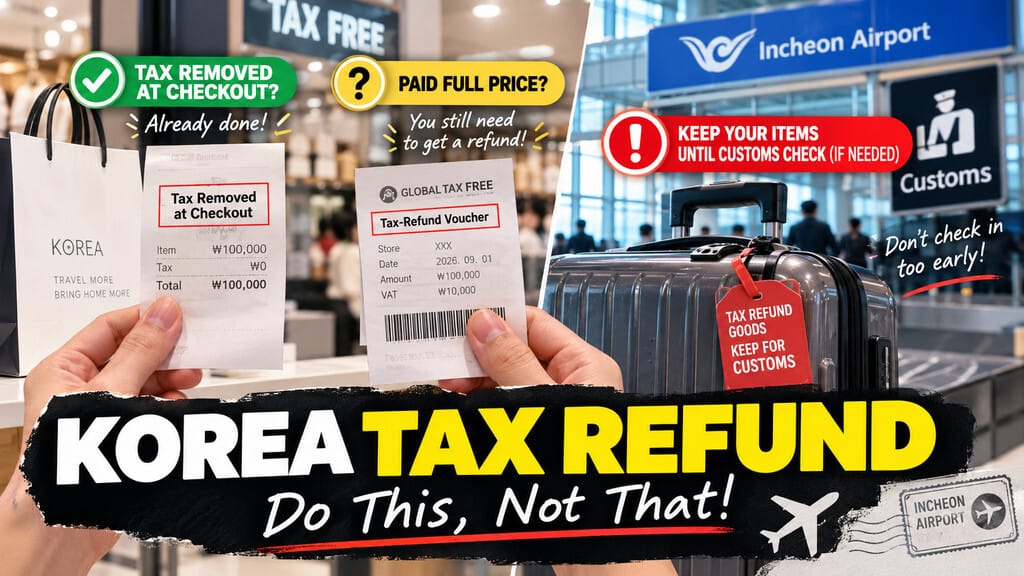
The most important airport rule is simple: if tax-refund goods may need customs confirmation and you plan to check them in, do not let the bag disappear onto the baggage belt before the required customs step is complete. At Incheon Airport, customs instructs travelers to keep applicable goods available for verification before checked baggage containing those goods is surrendered.
This guide focuses on goods bought at participating tax-refund stores. If you are still deciding what is worth buying, see What to Buy in Korea: Souvenirs and Useful Things Actually Worth Bringing Home. Korea also operates a separate VAT-refund scheme for eligible stays at designated accommodation facilities; that is not the same workflow as shopping tax refunds.
QUICK ANSWER
- Shop at a participating tax-refund store.
- Show your passport when the store or refund system requests identity verification.
- If the store offers an immediate tax refund, the eligible tax is deducted at checkout and you pay the reduced amount.
- If you pay the full tax-inclusive price, get the separate tax-refund voucher or sales certificate. A normal purchase receipt alone is not enough for the general refund process.
- Keep qualifying goods unused and unopened when the rules require them to remain export-ready.
- At departure, scan the passport and refund record at the applicable airport tax-refund/customs system.
- If customs inspection is required, present your passport, refund document and the actual goods.
- If those goods are going into checked baggage, complete the applicable customs step before handing the bag over.
- After export confirmation is complete, receive the approved refund through the applicable counter, kiosk, card, mobile or other supported provider method.
| Question | Current rule / practical answer |
|---|---|
| Minimum qualifying purchase | KRW 15,000 or more |
| General eligibility for foreign visitors | Generally foreigners staying in Korea for up to 6 months, subject to non-resident and other eligibility rules |
| Export deadline | Purchased goods must be taken overseas within 3 months |
| Immediate refund | Single transaction at least KRW 15,000 and under KRW 1,000,000; total immediate-refund purchases during the trip KRW 5,000,000 or less |
| Downtown refund | Single transaction KRW 6,000,000 or less |
| Airport general refund | No upper purchase limit stated for the airport/port post-refund method; the minimum purchase rule still applies |
| Ordinary store receipt enough? | No. Get the separate refund voucher / sales certificate issued through the participating store |
| Can you open or use the goods first? | Opened or used goods are listed as ineligible under the goods-refund scheme |
| Full 10% VAT back? | Usually no. VisitKorea says the practical refund is approximately 5–8% of the total purchase price after processing fees, depending on price, provider and refund method |
First: Tax Free, Duty Free and Tax Refund Are Not the Same Thing
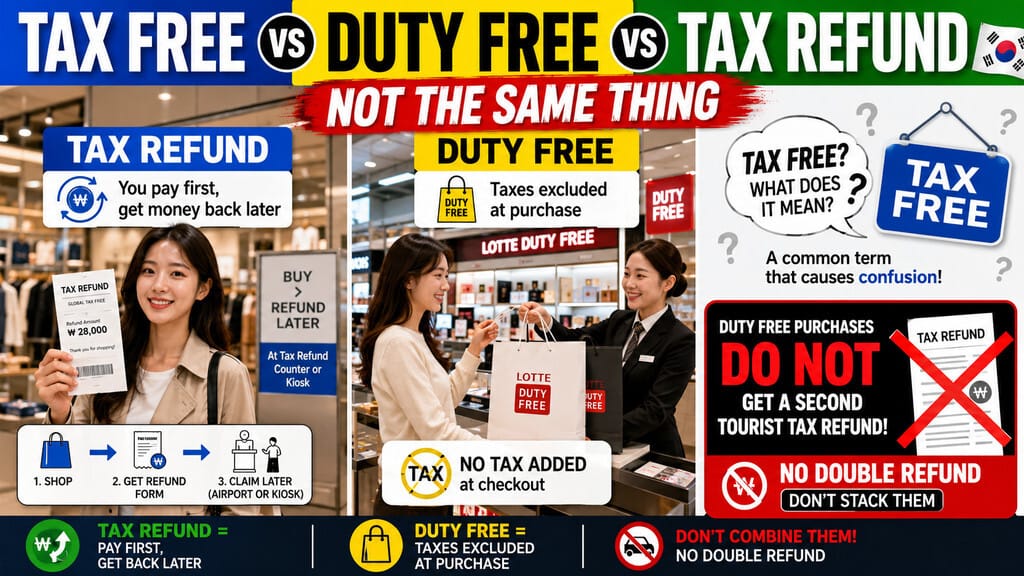
The wording around shopping in Korea can be confusing because “tax free,” “duty free” and “tax refund” are often used casually as if they mean the same thing.
Duty-free shopping
At a true duty-free store, eligible taxes are excluded under the duty-free system. You are not paying the normal tax-inclusive retail price and then asking for that same tax back through the tourist tax-refund process.
Tourist tax refund
At a tax-refund store, the goods are sold under Korea’s tourist refund system. Depending on the merchant and transaction, either the eligible tax is deducted immediately at checkout, or you pay the tax-inclusive price first and receive a refund later.
A product already bought through the duty-free system is not eligible for a second tourist tax refund. The two systems should not be stacked.
Who Can Get a Tourist Tax Refund in Korea?
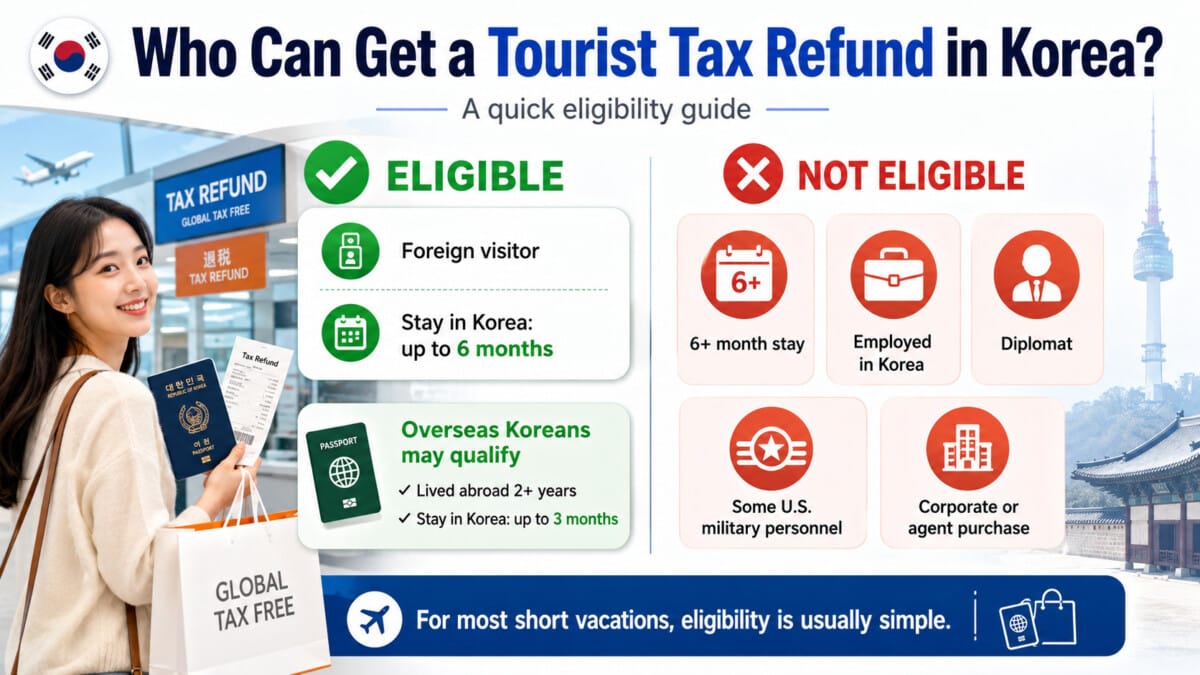
Korea’s current tourism guidance describes the goods-refund scheme as being for non-residents who do not earn income in Korea. For the typical foreign visitor, the most relevant rule is that a foreigner must be staying in Korea for up to six months.
Overseas Koreans can qualify under separate rules if they have lived abroad for at least two years and stay in Korea for no more than three months.
Common exclusions include:
- people staying in Korea for six months or longer;
- diplomats stationed in Korea;
- certain U.S. military personnel stationed in Korea;
- people employed in Korea;
- purchases made in a corporate name or by an agent.
For an ordinary short vacation, eligibility is usually straightforward. For long stays, work arrangements, diplomatic status or unusual residency situations, do not assume that holding a foreign passport by itself settles eligibility.
Which Purchases Qualify?
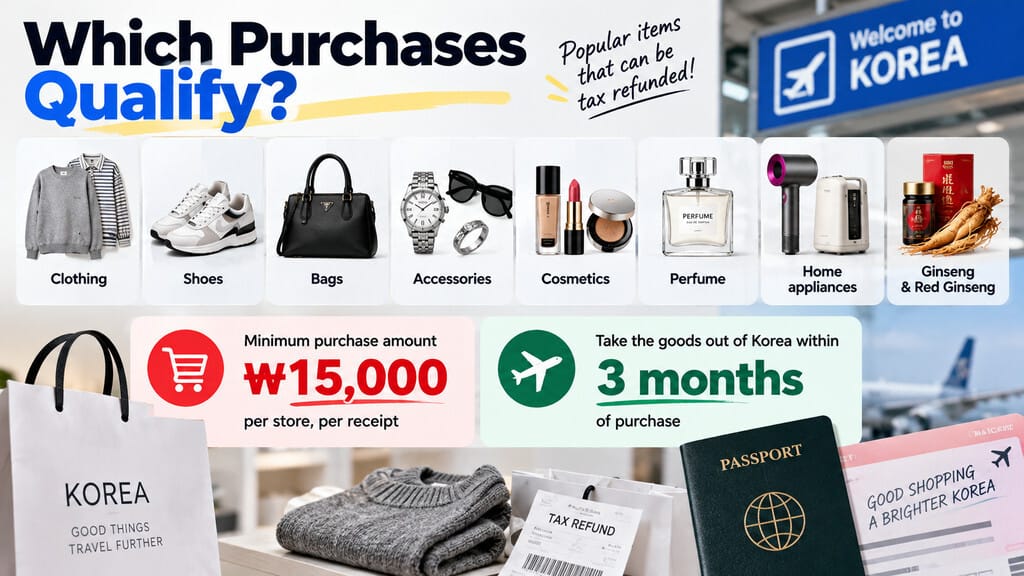
The current VisitKorea guide lists taxable goods such as clothing, shoes, bags, accessories, cosmetics, perfume, home appliances, ginseng and red ginseng as examples of refundable goods when the other conditions are met.
The basic minimum purchase amount is KRW 15,000, and qualifying goods must be taken out of Korea within three months of purchase.
What is not eligible?
Official guidance excludes, among other things:
- items prohibited by law;
- services that cannot be physically verified by customs, with examples including cooked food and massage services;
- goods that have already been opened or used before export;
- goods already purchased through the duty-free system.
This is why “I paid VAT” is not by itself enough to guarantee a tourist refund. The purchase must fit the tourist-refund scheme and come from a participating seller that can issue the required refund documentation.
Before You Pay: Check the Store and the Refund Method
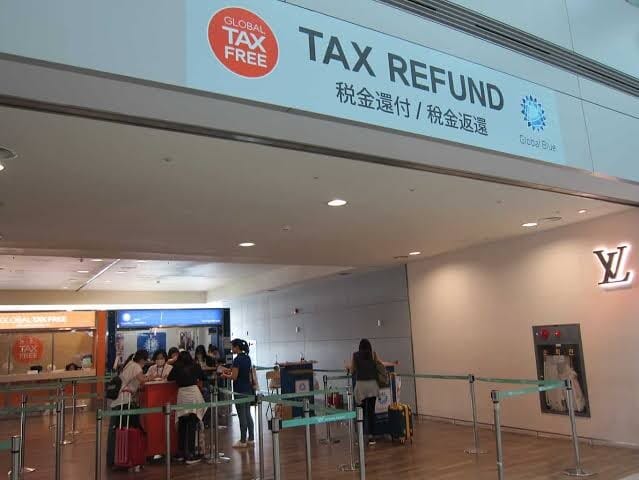
Not every shop in Korea participates in the tourist tax-refund program. Participating stores commonly display a Tax Refund or Tax Free sign together with the logo of a refund operator. VisitKorea lists examples such as Global Blue, Global Tax Free, Easy Tax Refund and CubeRefund.
Before paying, ask whether the specific branch offers a tourist tax refund. This matters because a brand may have many branches and the process can differ by location or register. If your overseas card fails at checkout, see Foreign Card Declined in Korea? What Tourists Should Do.
A useful checkout question is simply: “Can I get a tax refund for this purchase?” If yes, have your passport ready. Do not wait until your final day and assume the store can recreate all necessary documentation later.

The Document That Matters: A Normal Receipt Is Not Enough
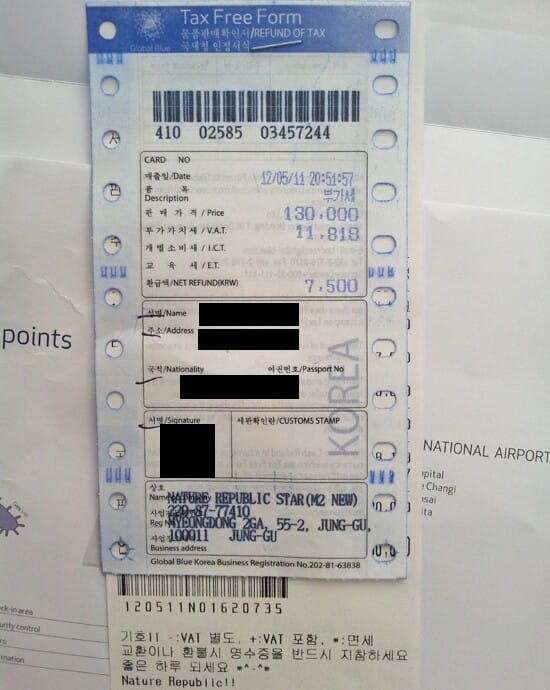
One of the easiest mistakes is keeping only the regular card receipt or cash receipt.
VisitKorea’s current FAQ states that an ordinary purchase receipt cannot be used by itself to claim the tourist tax refund. You need a separate tax-refund voucher issued through the affiliated store. Korea Customs likewise describes the export-confirmation document as a certificate of sale of goods.
The exact format can be paper or digitally encoded depending on the merchant and refund provider, but the practical rule is the same: before leaving the store, make sure the refund transaction has actually been registered and you have the voucher, barcode/QR document or provider record required for the later claim.
Option 1: Immediate Tax Refund at the Store
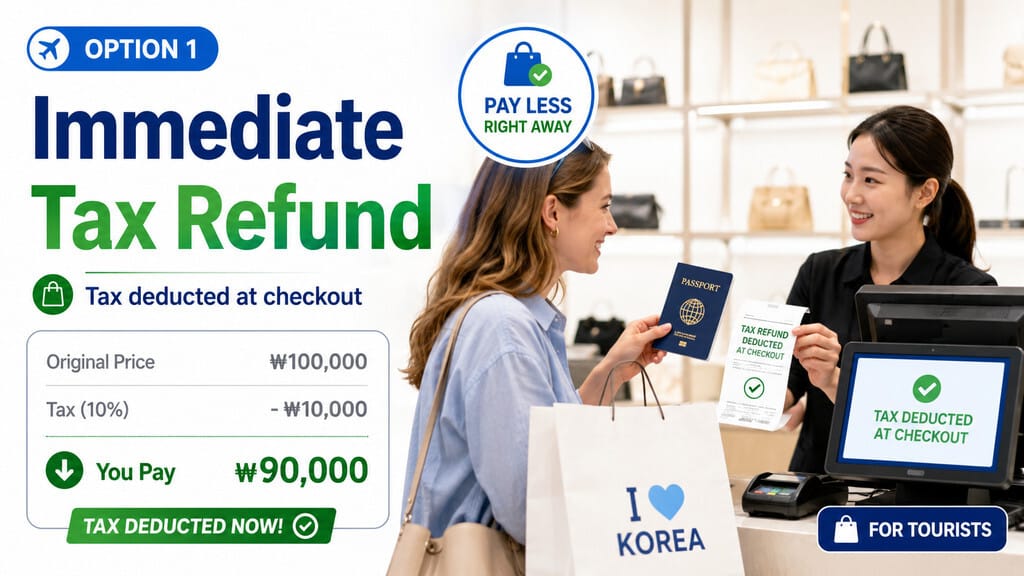
An immediate refund is the easiest version of Korea’s tourist tax-refund system. Instead of paying the full tax-inclusive price and getting money back later, the participating store verifies your eligibility and deducts the eligible tax amount at checkout.
Current immediate-refund limits
- the transaction must be KRW 15,000 or more;
- a single immediate-refund transaction must be under KRW 1,000,000;
- the total amount of purchases processed through immediate refund during the trip must be KRW 5,000,000 or less.
The “under KRW 1,000,000” wording matters: a transaction of exactly KRW 1,000,000 is not within the stated single-transaction immediate-refund limit.
What you do at checkout
- Confirm that the store offers immediate tourist tax refund.
- Present your passport for eligibility verification.
- The eligible tax is deducted from the price.
- Pay the reduced amount.
VisitKorea’s immediate-refund procedure then ends with departure from Korea; there is no separate step to collect the same refund again at the airport. If the tax was already deducted at the store, there is no second refund waiting for that transaction.
Option 2: General Tax Refund After Paying the Full Price

If the store does not process an immediate refund—or the transaction does not fit the immediate-refund limits—you may pay the tax-inclusive price and receive a general refund later.
The general system can be completed through several channels:
- downtown refund counter or kiosk;
- airport refund counter or kiosk;
- mailbox where supported;
- mobile refund service provided by the refund operator.
The important point is that the refund-payment channel and customs export confirmation are not always the same step. Receiving money early at a downtown counter does not automatically mean that every departure requirement is finished.
Downtown Tax Refund: Convenient, But You Still Need the Departure Step
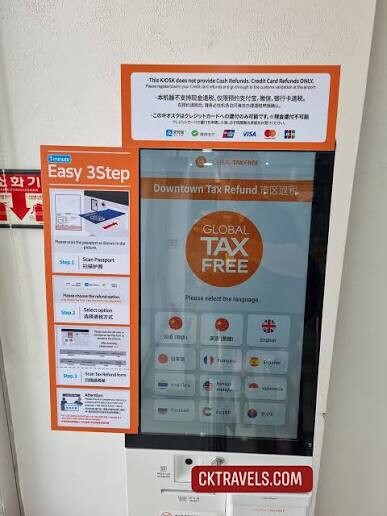
A downtown refund lets you receive the refund before departure at a participating city refund counter or kiosk.
The current downtown limit is a minimum qualifying purchase of KRW 15,000 with a single transaction of KRW 6,000,000 or less. VisitKorea says downtown processing requires the passport, refund voucher and a credit card. Downtown counters generally process the refund operator they belong to rather than every company.
The important catch: even after receiving the refund downtown, you still need to complete the required customs export confirmation when leaving Korea. Downtown refund means the payment happens earlier; it does not erase the obligation to prove export when confirmation applies.
Airport General Refund: The Straightforward Fallback
The airport method is the default option when you paid the tax-inclusive price and still need to claim the refund. Korea Customs’ April 2026 summary states that the airport/port post-refund method has no upper purchase-amount limit, unlike immediate and downtown refund. The standard minimum qualifying purchase rule still applies.
The simplified flow is:
- Arrive with the goods, passport and refund records accessible.
- Use the tax-refund/customs kiosk where available.
- Follow the screen instructions and check whether customs inspection is required.
- If selected, present the actual goods and documents to customs.
- Complete checked-baggage handling in the correct order.
- Go through security and immigration.
- Receive the approved refund at the applicable counter/kiosk or through the selected supported payment method.
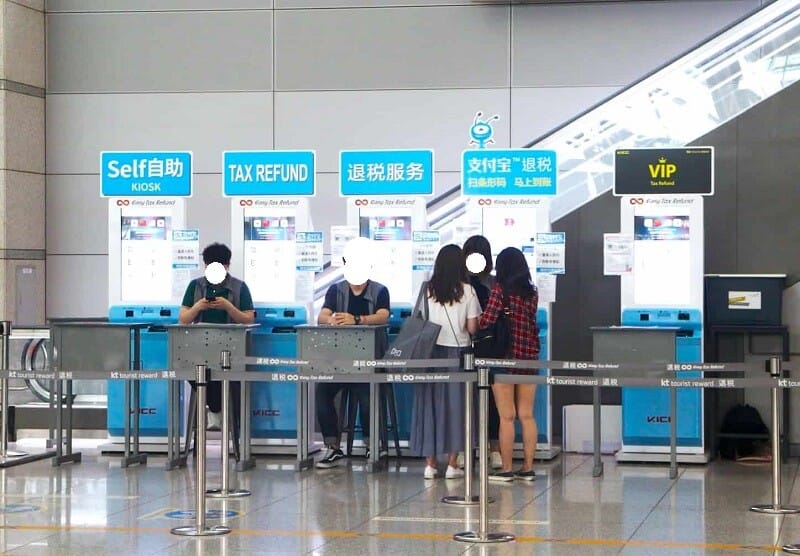
The Airport Step People Get Wrong: Checked Baggage
If an item that may need customs verification is inside a suitcase you plan to check, do not check the suitcase normally and then try to find customs afterward.
Korea Customs requires the traveler to have the goods available for verification. Incheon Airport Customs specifically instructs travelers to present applicable tax-refund goods before the baggage is finally checked.
Practical Incheon Airport sequence for checked baggage
- Bring the purchased goods to the tax-refund/customs kiosk and scan the passport and sales/refund confirmation.
- Check whether the system selects the transaction for customs inspection.
- Complete airline check-in and have a baggage tag attached, but keep possession of the bag containing the goods when customs verification is still required.
- For checked baggage selected for verification, take the goods and confirmation document to the designated customs area around the oversized-baggage process as directed.
- After customs verifies the goods, hand the bag over for checked baggage.
- Continue through departure procedures.
- Collect the approved refund at the applicable tax-refund point or through the selected supported method.
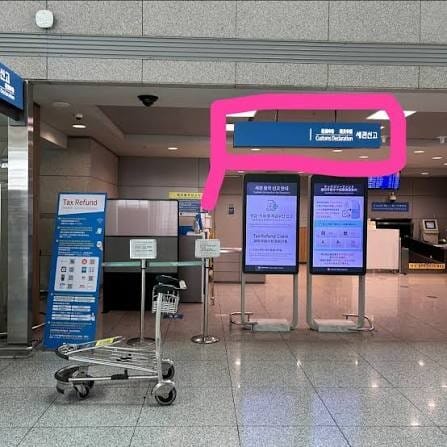
The exact counter or kiosk can vary by terminal and refund provider. The sequence matters more than memorizing one counter number.
What If the Goods Are in Carry-On Baggage?
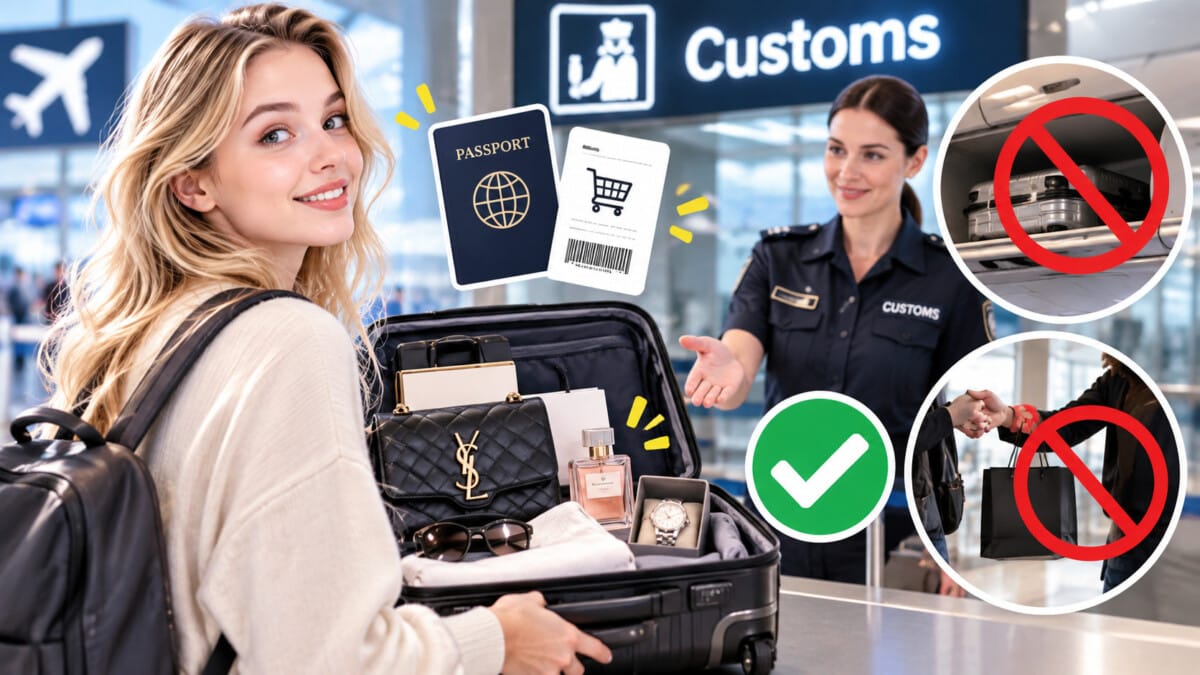
Carry-on is simpler because the goods remain with you. Incheon Airport Customs distinguishes carry-on goods from checked goods. If customs inspection is required, carry-on goods can be presented with the passport and sales/refund confirmation at the designated customs area.
The core rule remains the same: you must be able to physically show the qualifying goods if customs asks to inspect them. Do not pack a high-value refund item somewhere inaccessible or give it to a travel companion leaving through a different terminal before the refund process is complete.
Customs Kiosk vs. Refund Kiosk: Think in Two Functions
Airport signage can make the process look like one “tax refund kiosk” task, but conceptually there are two separate functions.
1. Export/customs confirmation
Korea Customs uses automated kiosks at equipped airports to read the passport and commodity sales/refund confirmation. If the system selects the goods for inspection, you must go to customs and present the goods.
2. Refund payment
After the refund record is approved, payment can be handled through an airport refund counter, automated refund kiosk, card or another supported method depending on the operator and location. Separating these two ideas explains why simply scanning a voucher does not always mean the whole process is finished.
Incheon Airport Terminal 1 and Terminal 2: Where Do You Go?
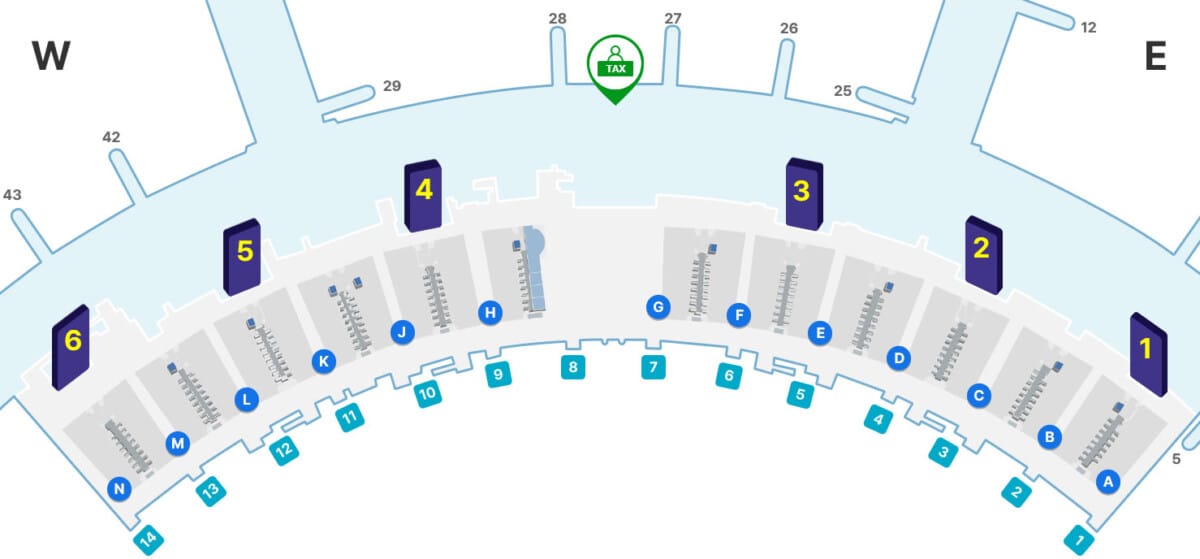
Current official airport and tourism pages list multiple tax-refund facilities in both terminals. However, official facility pages do not always present exactly the same gate or counter references, and airport tenants can move.
At Terminal 1, official airport information lists tax-refund facilities in the public check-in area and airside refund points. At Terminal 2, official information likewise lists public-side facilities and airside refund locations, but specific gate references can differ between official pages.
Because of that, do not build your departure plan around one memorized gate number.
Better strategy at the airport
- First confirm whether you are departing from T1 or T2.
- In the public check-in area, follow signs for Tax Refund / Customs before surrendering checked baggage that may need inspection.
- Use the airport’s current information display, information desk or official airport map for the live location.
- After security and immigration, follow the approved refund record to the applicable refund counter or kiosk.
This avoids a common failure: heading straight to an airside refund desk after your checked bag—and the goods customs may need to see—are already inaccessible.
Do You Always Need to Show the Physical Goods to an Officer?
Not every refund transaction necessarily results in manual inspection. At airports equipped with automated kiosks, Korea Customs says travelers enter or scan the passport and sales confirmation first. If the transaction is selected for inspection, they must visit the customs inspection team.
That is why the safest approach is not to guess whether your purchase is “expensive enough” or “small enough” to be ignored. Keep the goods available until the kiosk/customs process tells you what is required.
Why You Usually Do Not Get the Full 10% VAT Back
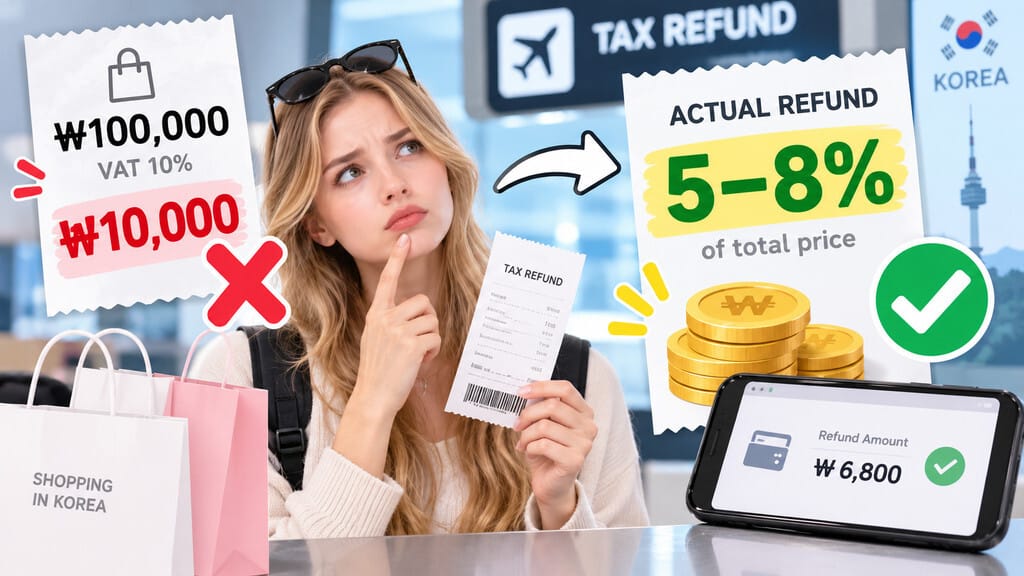
A common expectation is that Korea’s 10% VAT means a KRW 100,000 purchase should produce exactly KRW 10,000 back. That is not how the tourist-refund payout should be estimated.
VisitKorea’s current FAQ says the actual refund is approximately 5–8% of the total purchase price after the tax-refund processing fee. The amount can vary depending on the purchase amount, refund provider and refund method. Credit-card or mobile-payment refunds can also involve separate fees.
Treat the amount shown on the refund voucher or provider system as the useful estimate instead of manually multiplying the retail price by 10%.
Cash, Credit Card or Mobile Refund?
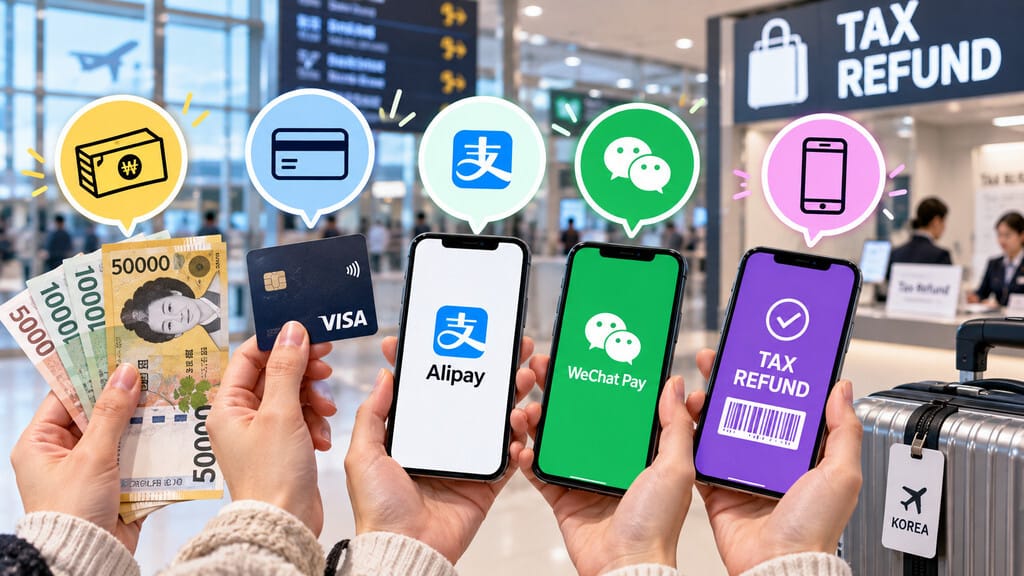
Available payout methods depend on the operator and location. If you plan to receive or carry some won during the trip, How Much Cash Should You Carry in Korea as a Tourist? covers the broader cash question.
Current official tourism and airport information shows combinations of cash, credit-card refund, Alipay, WeChat Pay and provider mobile-refund channels. Exact supported methods and fees are provider-specific.
For card refunds, processing time can vary by card issuer and refund provider. Do not assume a valid refund failed only because the credit does not appear instantly.
Mailbox and Mobile Refunds
Korea’s general refund system also supports mailbox and mobile methods in applicable situations.
Mailbox
Where an airport or port does not have the required refund counter/kiosk—or where a mailbox process is provided—you can submit an export-confirmed refund voucher after filling in the purchaser and refund-method information required on the form.
Mobile
VisitKorea says travelers can apply through a mobile refund site or application provided by the tax-refund service provider after the required export-confirmation process. A mobile app does not turn an unverified export into a valid claim.
Multiple Refund Companies on One Trip

You may shop at stores using different refund operators. Keep vouchers organized by provider, especially if you use downtown refund counters.
VisitKorea states that a downtown counter generally handles refunds for its own company, whereas airport and port refund facilities can handle the broader set of operators. At the airport, follow the barcode/QR or provider information on each voucher and use the official tax-refund area. If a kiosk cannot process a particular voucher, take it to staff rather than assuming the purchase is invalid.
Can You Open Cosmetics, Clothes or Electronics Before Leaving Korea?
Official goods-refund rules list opened or used goods as ineligible, and Korea Customs describes goods presented for outbound verification as unopened and unused.
If a purchase matters enough that you are counting on the refund, the safest approach is to keep it in export condition until the relevant customs requirement is complete.
- cosmetics you are tempted to start using during the trip;
- electronics you want to set up immediately;
- packaged health products or ginseng;
- clothing or accessories where use could create a dispute about whether the item is being exported as purchased.
Do not rely on “they probably will not check.” The system is based on the qualifying goods being taken out of Korea.
What About Food, Restaurants and Services?

A restaurant bill is not treated like a refundable bag or cosmetic purchase. VisitKorea lists cooked food and massage services as examples of services that are not visually verifiable by customs and therefore are not eligible under the goods-refund scheme.
Packaged taxable goods sold through a participating tax-refund retailer can be different. The official guide lists ginseng and red ginseng among examples of eligible taxable goods. The distinction is whether you are exporting a qualifying physical good through the tourist-refund system.
What About Hotels?

Korea has a separate accommodation VAT-refund scheme for eligible foreign individual travelers staying at specially designated accommodation facilities.
VisitKorea states that the eligible room charge can cover up to 30 nights, including breakfast only when it is included in the room rate. Separately purchased breakfast, service charges, stays beyond 30 nights and package-tour group travelers are excluded from that accommodation scheme.
Because the hotel scheme has different participating properties and documentation, do not use a shopping refund voucher workflow as a substitute for the hotel’s own VAT-refund instructions.
Common Tax-Refund Mistakes

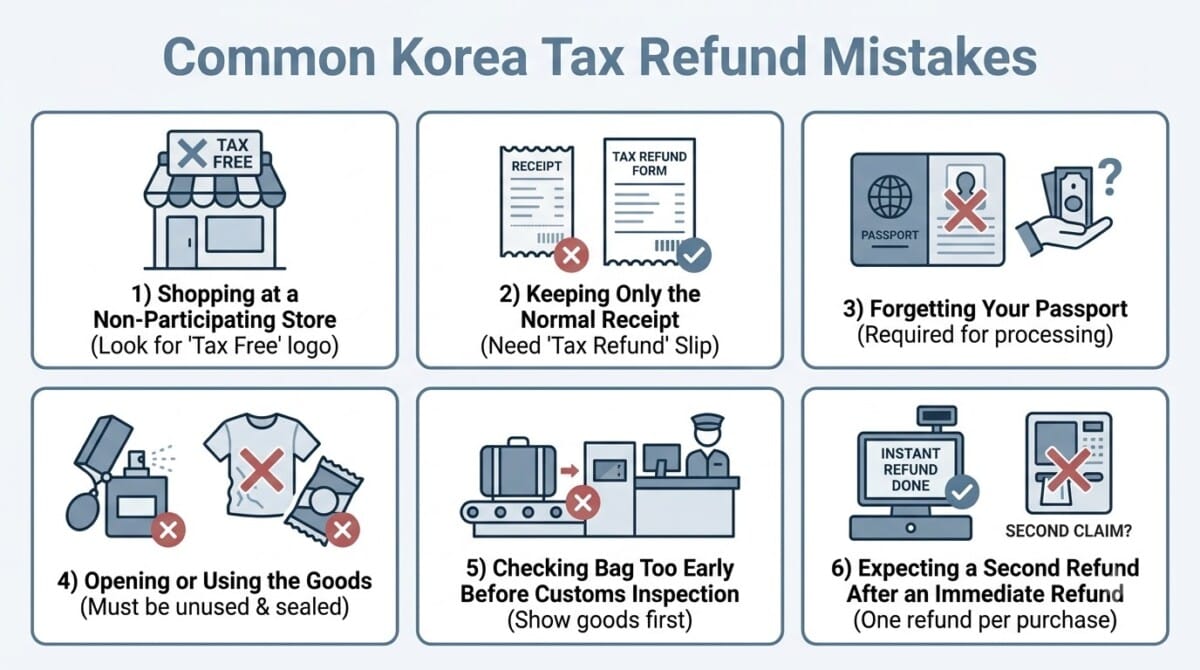
Mistake 1: Assuming every store offers a refund
A normal VAT-paying store is not automatically a tourist-refund store. Check before paying.
Mistake 2: Leaving with only the card receipt
A regular receipt is not the refund voucher. Make sure the participating seller registers the refund and gives you the required voucher or digital record.
Mistake 3: Forgetting your passport
Passport verification is central to immediate refund and is required for downtown processing and customs confirmation. Do not assume a screenshot or photocopy will replace the passport unless the specific system explicitly accepts it.
Mistake 4: Opening or using the goods
Official guidance lists opened or used goods as ineligible. If you are relying on the refund, keep them export-ready.
Mistake 5: Checking the suitcase too early
This is the major airport failure. If customs needs to see the goods, they cannot inspect a suitcase that has already disappeared into the baggage system. At Incheon, complete the applicable customs step before surrendering checked baggage containing goods that need inspection.
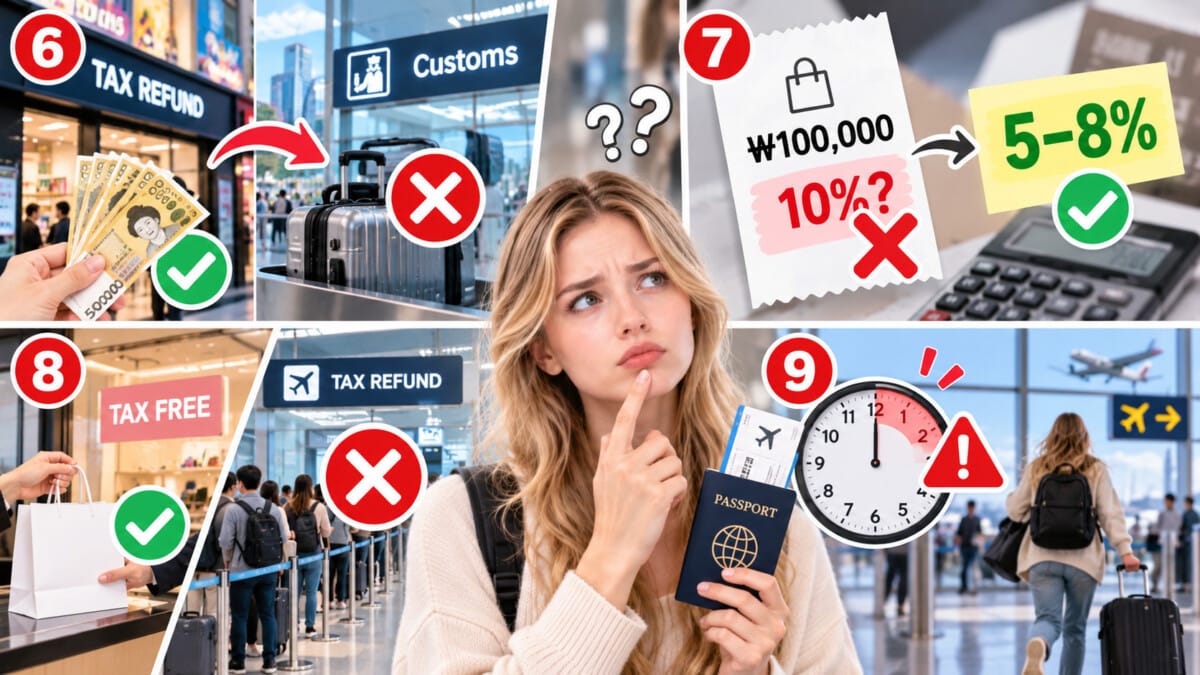
Mistake 6: Thinking downtown refund means airport customs is irrelevant
The downtown method pays earlier, but the departure export-confirmation requirement still applies.
Mistake 7: Expecting exactly 10% back
The payout is not simply retail price × 10%. VisitKorea estimates roughly 5–8% after processing fees, with provider and payment-method differences.
Mistake 8: Mixing up immediate and general refunds
If the store already deducted the tax, do not queue at the airport expecting the same refund a second time.
Mistake 9: Leaving the airport process until the last minute
The tax-refund/customs process adds extra stops, and manual inspection can take longer than a simple kiosk scan. Build extra airport time into a shopping-heavy trip rather than treating the refund as a two-minute task.
A Practical Departure Checklist
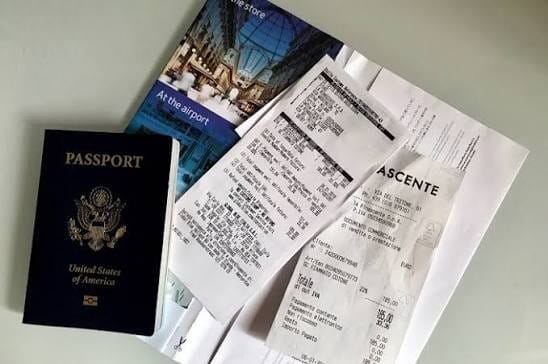
Before leaving your hotel
- Passport
- Boarding information
- Refund vouchers / QR or barcode records
- Qualifying goods kept accessible
- Goods not opened or used if relying on refund eligibility
- Refund vouchers grouped by provider if you have many purchases
At the airport, before checking baggage
- Confirm your terminal.
- Find the Tax Refund / Customs area in the public check-in zone.
- Scan or process the passport and refund records as instructed.
- Check whether any transaction is selected for customs inspection.
- If selected, present the goods and documents.
- Only then hand over checked baggage containing those goods.
After security and immigration
- Follow the approved refund record to the applicable counter or kiosk.
- Select the supported refund method.
- Keep the voucher or confirmation until the refund is received, especially for delayed card/mobile payments.
What If You Are Running Out of Time?
Prioritize the step you cannot recreate after departure: the required customs export confirmation while you still physically have the goods in Korea.
A provider may offer card, mobile or mailbox processing for an export-confirmed transaction. But if you leave Korea without completing a required customs confirmation, do not assume the refund company can fix that remotely later.
If you are already airside and realize a qualifying item is inside checked baggage, ask airport/refund staff immediately. Do not assume you can simply submit the receipt online after landing abroad.
What If You Missed the Refund at the Airport?
You completed customs/export confirmation but did not collect the money
Depending on the refund provider and voucher, a card, mobile or mailbox route may still be available. Follow the operator instructions printed or encoded on the refund record.
You never completed required export confirmation
This is much harder. The official system is built around proof that the goods were taken out of Korea. Once you have departed without the required confirmation, do not assume a later photo of the item or an ordinary receipt can replace the customs step.
Contact the refund operator shown on the voucher with the exact transaction details, but treat recovery as provider- and case-specific rather than guaranteed.
FAQ
Do tourists get tax refunds automatically in Korea?
No. The purchase must be made through a participating tax-refund seller and you must follow the applicable immediate or general refund process.
What is the minimum purchase for a Korea tax refund?
KRW 15,000 is the current minimum qualifying purchase amount.
Do I need my passport when shopping?
For immediate refund, passport verification is part of checkout. The passport is also required for downtown processing and customs/export confirmation in the general system. Carry it when you expect to make a tax-refund purchase.
Can I get the refund in Seoul instead of Incheon Airport?
Yes. Participating downtown refund counters and kiosks can process eligible general refunds, subject to the KRW 6,000,000-per-transaction downtown limit and provider rules. You still need the required export confirmation when leaving Korea.
Is there a maximum purchase amount for airport tax refund?
Korea Customs’ 2026 summary states that the airport/port post-refund method has no upper purchase limit. Immediate and downtown methods have separate caps.
Do I need the goods with me at customs?
If customs verification is required, yes. Korea Customs requires the passport, sales/refund confirmation and the actual purchased goods for inspection.
Can I check tax-refund goods in my suitcase?
Yes, but at Incheon Airport the applicable customs verification must happen before the bag is surrendered when the goods need inspection. Get the baggage tag, keep the bag with you for the customs step, and check it afterward.
Do I get 10% back?
Usually not. VisitKorea says the practical refund amount is approximately 5–8% of the total purchase price after processing fees, depending on the price, refund provider and refund method.
Can I use the product during my trip and still claim the refund?
Official guidance lists opened or used goods as ineligible. If you are relying on the refund, keep the goods unused and unopened until the applicable export requirement is complete.
Is a credit-card receipt enough?
No. You need the separate tax-refund voucher or registered refund record from the participating store.
Official Sources
- Korea Tourism Organization (VisitKorea) — Comprehensive Tax Refund Guide
- Korea Tourism Organization (VisitKorea) — Tax Refund FAQ / Precautions
- Korea Customs Service — Tax Refund
- Incheon Airport Customs — TAX-REFUND departure procedure
- Incheon International Airport — Domestic Tax Refund
- Korea Customs Service — April 3, 2026 tax-refund policy summary
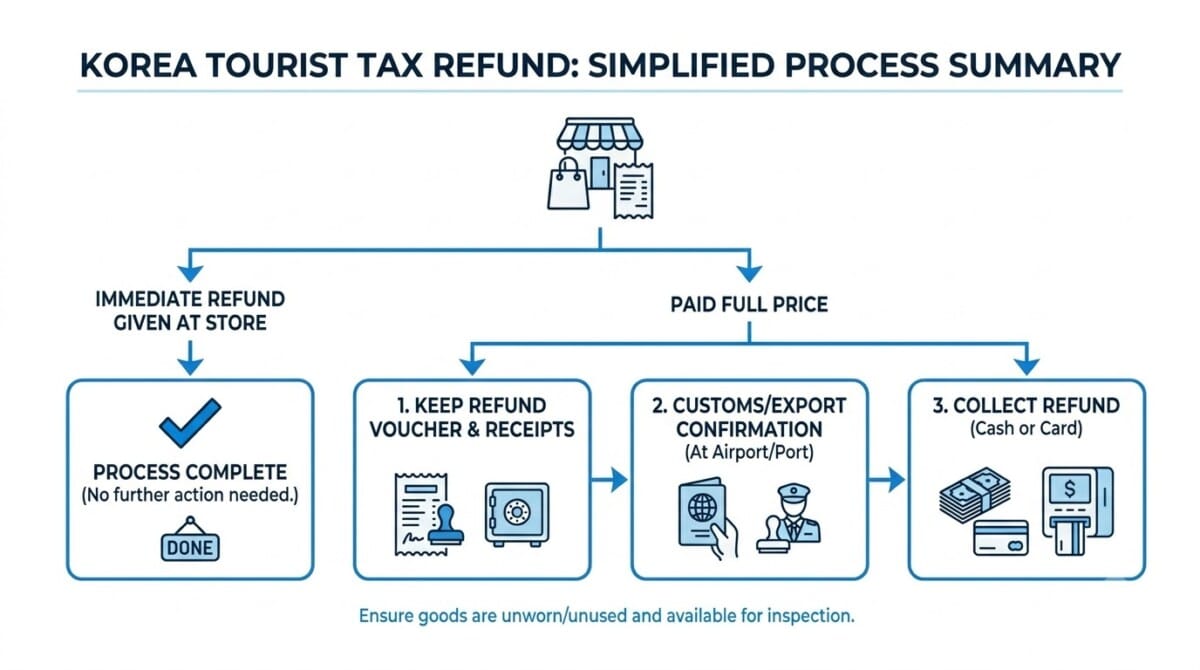
The simple version
If the store removes the tax immediately, your refund is already handled. If you paid the full price, keep the proper refund voucher and the goods, then complete the required export/customs process before collecting the refund.
At Incheon Airport, the rule worth remembering is this: tax-refund goods that may need customs inspection stay with you until customs is finished—even if you plan to check them as baggage.
Travel information can change. Refund operators, airport counters, kiosks and opening hours may move or change, so verify the current airport location on your departure day.